Back to Firm News
Firm News
June 27, 2026
Applications Open for "Mentoring for Change": A Transformational Mentorship Programme for Global Changemakers
Talent is evenly distributed. Access to guidance is not. The development sector frequently loses its most promising early-to-mid career practitioners at the exact moment they need structured guidance the most. While many possess strong technical foundations, they often lack access to the experienced, honest mentorship required to navigate institutional complexities, build strategic networks, and sustain their commitment to inclusive development over the long term.
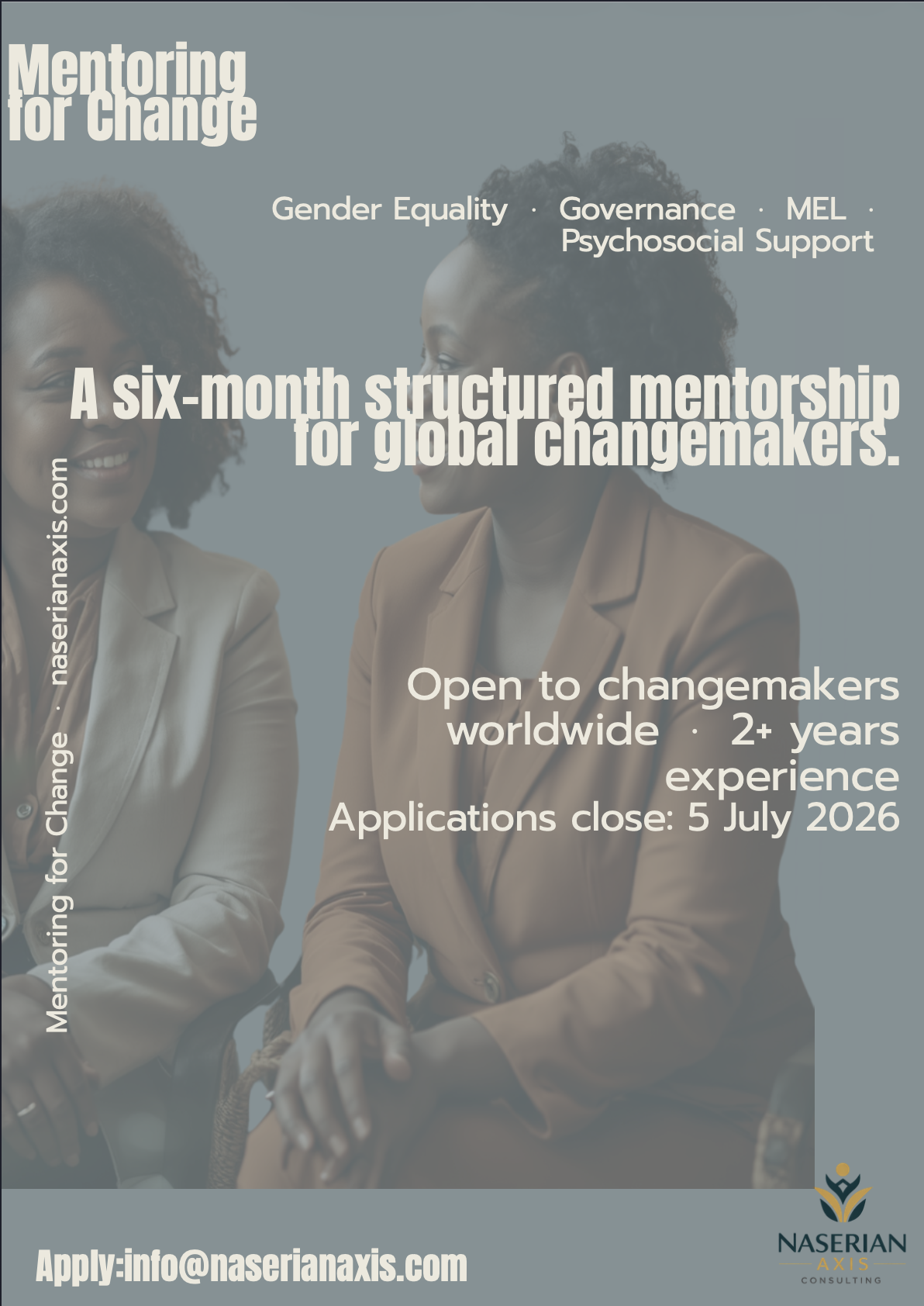
To bridge this gap, we are thrilled to announce the launch of Mentoring for Change, a six-month virtual structured mentorship program connecting early-to-mid-career practitioners with senior development professionals.
More Than Just Technical Training Mentoring for Change is not a workshop or a standard training course. It is a sustained, six-month relationship with a senior practitioner who has already navigated the terrain mentees are entering. The program focuses on four core pillars:
1. Gender Equality
2. Equality Governance
3. Monitoring Evaluation and Learning (MEL)
4. Psychosocial Support
1. Gender Equality
2. Equality Governance
3. Monitoring Evaluation and Learning (MEL)
4. Psychosocial Support
Prioritising Psychosocial Wellbeing
Psychosocial wellbeing is the most consistently underfunded competency in the development workforce and the primary driver of practitioner burnout. By integrating psychosocial support alongside technical pillars, Mentoring for Change recognises that sustainable development practice begins with sustainable practitioners. Mentees will learn to build emotional resilience, manage workplace difficulties, and maintain personal purpose across demanding careers.
Meet Your Mentors Participants will receive one-to-one guidance tailored to their specific context from world-class senior practitioners, including:
Shamsa Suleiman Al Habsi: Gender Equality Specialist with 14+ years of experience designing gender-transformative programmes in fragile settings.
Jamila Lugembe: Co-Founder of Naserian Axis Consulting LLC, managing over $39M in programs across human rights, GESI, WPS, and governance.
Iman R. Hatibu: Co-Founder of Naserian Axis Consulting LLC, Business Development & Operations Lead, and expert in communications and designing feminist organizational systems at scale.
Sizarina Hamisi: Gender Policy Specialist and Strategic Adviser with 15+ years of extensive experience translating evidence into government action.
Transformational Outcomes Over the six months, mentees will build the professional confidence to lead, expand their networks across geographies and sectors, and develop the emotional regulation and boundary-setting practices needed to remain in the development sector for the long term.
Inclusive development practice cannot just be taught; it must be modeled. Applications are now open to women, men, and non-binary individuals from across the globe.
Shamsa Suleiman Al Habsi: Gender Equality Specialist with 14+ years of experience designing gender-transformative programmes in fragile settings.
Jamila Lugembe: Co-Founder of Naserian Axis Consulting LLC, managing over $39M in programs across human rights, GESI, WPS, and governance.
Iman R. Hatibu: Co-Founder of Naserian Axis Consulting LLC, Business Development & Operations Lead, and expert in communications and designing feminist organizational systems at scale.
Sizarina Hamisi: Gender Policy Specialist and Strategic Adviser with 15+ years of extensive experience translating evidence into government action.
Transformational Outcomes Over the six months, mentees will build the professional confidence to lead, expand their networks across geographies and sectors, and develop the emotional regulation and boundary-setting practices needed to remain in the development sector for the long term.
Inclusive development practice cannot just be taught; it must be modeled. Applications are now open to women, men, and non-binary individuals from across the globe.
Part 2: Instructions for Application
How to Apply for Mentoring for Change
Thank you for your interest in the Mentoring for Change programme.
Please review the eligibility criteria and application steps below carefully before submitting your application.
1. Check Your Eligibility This programme is open to everyone, regardless of gender, who meets the following criteria:
Experience: Early-to-mid career practitioner with at least 2+ years of experience in development, governance, social work, education, or community leadership.
Location: Based anywhere in the world (the programme is fully virtual).
Focus Area: Currently working in or aspiring to work in gender equality, governance, MEL (Monitoring, Evaluation, and Learning), WPS (Women, Peace, and Security), or related fields.
Qualifications: No specific academic qualification is required. What matters is your commitment to inclusive development practice and personal growth.
2. Understand the Commitment Before applying, please ensure you can commit to the following over the 6-month program:
Attending virtual, one-to-one monthly sessions with your assigned mentor.
Actively engaging in self-reflection and professional development exercises.
Remaining open to honest feedback, accountability, and being genuinely challenged by your mentor.
3. Prepare Your Application Materials
An updated CV/resume highlighting your 2+ years of relevant experience.
A brief statement of interest detailing your current career challenges, what you hope to gain from the program, and your commitment to the focus areas (Gender, Governance, MEL, or Psychosocial Support).
4. Submit Your Application
Apply via info@naserianaxis.com
Application Deadline: 5 July 2026
What Happens Next? Successful applicants will be matched with a senior mentor based on their geographic, cultural, and institutional context to ensure a mutually beneficial, two-way learning dynamic. By the end of the program, you will receive a certificate of completion and gain access to a peer network of practitioners across East Africa and the diaspora.
Thank you for your interest in the Mentoring for Change programme.
Please review the eligibility criteria and application steps below carefully before submitting your application.
1. Check Your Eligibility This programme is open to everyone, regardless of gender, who meets the following criteria:
Experience: Early-to-mid career practitioner with at least 2+ years of experience in development, governance, social work, education, or community leadership.
Location: Based anywhere in the world (the programme is fully virtual).
Focus Area: Currently working in or aspiring to work in gender equality, governance, MEL (Monitoring, Evaluation, and Learning), WPS (Women, Peace, and Security), or related fields.
Qualifications: No specific academic qualification is required. What matters is your commitment to inclusive development practice and personal growth.
2. Understand the Commitment Before applying, please ensure you can commit to the following over the 6-month program:
Attending virtual, one-to-one monthly sessions with your assigned mentor.
Actively engaging in self-reflection and professional development exercises.
Remaining open to honest feedback, accountability, and being genuinely challenged by your mentor.
3. Prepare Your Application Materials
An updated CV/resume highlighting your 2+ years of relevant experience.
A brief statement of interest detailing your current career challenges, what you hope to gain from the program, and your commitment to the focus areas (Gender, Governance, MEL, or Psychosocial Support).
4. Submit Your Application
Apply via info@naserianaxis.com
Application Deadline: 5 July 2026
What Happens Next? Successful applicants will be matched with a senior mentor based on their geographic, cultural, and institutional context to ensure a mutually beneficial, two-way learning dynamic. By the end of the program, you will receive a certificate of completion and gain access to a peer network of practitioners across East Africa and the diaspora.